
The short answer: A corporate hiring gap costs nothing until the day it costs everything. The functions companies leave short during growth, HR support, finance oversight beyond the controller, and internal operations, rarely fail loudly. They fail quietly, then all at once. The trigger is a missed compliance deadline, a reporting error, or a bottleneck stalling three departments in one week.
This is written for operations, finance, and HR leaders at growing employers deciding which corporate function to staff next, not for candidates weighing a move.
In this guide:
- Why Growth Hides These Corporate Hiring Gaps
- How Do You Spot a Corporate Hiring Gap Before It Costs You?
- Which Three Corporate Functions Do Growing Companies Skip First?
- When the Gap Finally Shows Up, It Costs More to Fix
- Three Numbers That Show Whether You're Closing the Gap
- Frequently Asked Questions
- The Bottom Line on Corporate Hiring Gaps
- References
Hires in professional and business services fell by 188,000 in July 2026. The country still carried 7.3 million open jobs, a 4.4 percent opening rate. The figures are the Bureau of Labor Statistics' own, from its Job Openings and Labor Turnover Survey. Growing companies are not failing to hire; they are hiring unevenly, revenue-facing roles first and support functions months later.
Journey Search Partners sees the same pattern from the inside of its own intake calls. A company reaches out about one open operations or finance role. The intake conversation is built to map the business's full hiring picture rather than the single seat in front of it, and it regularly turns up a second, unnamed gap sitting one function over. The role a company calls about is rarely the only one running short, just the one that finally made noise.
This guide names the corporate functions that go quiet longest and explains why growth hides the gap instead of revealing it. It also gives leaders a way to check their own org chart before the gap becomes the emergency.
Why Growth Hides These Corporate Hiring Gaps
Revenue growth adds headcount where the growth is visible and leaves everything else to catch up later, often for a year or more. The Corporate Finance and Accounting Talent Research Study shows how fast that mismatch can turn. The finance and accounting Talent Shortage Index moved from a 108 percent surplus in 2025 to a 77 percent shortage in 2026.
The accompanying Hiring Index climbed to 134 percent, a rebound to pandemic-era hiring intensity. A sales team that doubles in eighteen months shows up in a pipeline report someone reviews weekly. HR, finance oversight, and internal operations have no equivalent scoreboard, so they grow only once someone notices they are behind. NFIB's research on small employers shows how uneven that hiring already runs. Thirty-four percent report a job opening they cannot fill. Of those hiring or trying to hire, 47 percent say few or no applicants for the role are qualified.
The same asymmetry shows up in HR. Human Resources specialist employment is growing faster than the average occupation, with a median pay of $75,940. The Bureau of Labor Statistics projects roughly 73,700 openings a year through 2035 as that six percent growth plays out. Yet HR headcount at the smallest employers grew only about 4.7 percent since 2018, against 11 percent or more industry-wide. A company scaling revenue staffs HR against its own headcount curve, not that national rate.
How Do You Spot a Corporate Hiring Gap Before It Costs You?
Pull up the org chart and check three things. Which corporate functions have exactly one person doing work that used to take two? Which decisions are still routed through a founder or a department head because no one else can make the call? And which reports get produced late more often than not?
One person, two jobs' worth of work. The clearest sign is a role that absorbed a second one nobody backfilled. A controller who is also running payroll administration, an operations manager who is also the de facto HR contact. That consolidation looks efficient for a quarter or two. It stops working the moment that person takes vacation, gets promoted, or leaves, and the company discovers it was running two functions on one set of shoulders. That is the point where many operations leaders start scoping the next executive hire instead of a stopgap.
Decisions still routed through one person by habit, not by design. A second, quieter sign: whether a founder or department head still personally approves things a dedicated function should own. Not because the org chart says so, but because nobody built that function. That is a corporate hiring gap wearing a founder's calendar as a disguise.
Reports that arrive late more often than on time. A finance or HR function running thin rarely announces it. It shows up as month-end close sliding a week, or a filing that goes out the day it is due instead of the week before. One late report is a bad week; a pattern is a staffing gap the calendar is reporting for you.
Which Three Corporate Functions Do Growing Companies Skip First?
HR, finance oversight beyond the controller, and internal operations carry more of this hiring-gap risk than any others. Each stays invisible for a different reason. Two, HR and finance oversight, sit inside occupations projected to grow faster than average, so the talent to close the gap already exists.
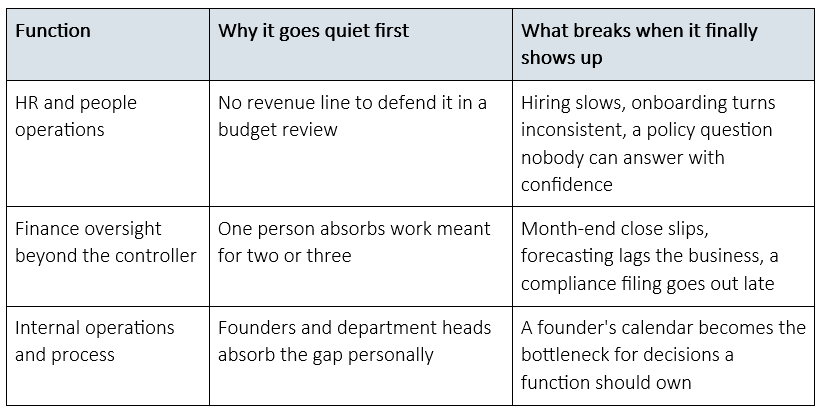
HR and finance oversight carry the heaviest weight here because their absence shows up as risk, not as an obvious output gap. Internal operations earns its place for a different reason: nothing on an org chart names it, so it survives only as whatever a founder personally absorbs. A search built to map the whole org chart often turns up a second opening in one of these three nobody had named yet.
When the Gap Finally Shows Up, It Costs More to Fix
A corporate hiring gap rarely announces itself as a hiring problem. It shows up first as one of three signals: a missed compliance filing, an uncaught reporting error, or a decision bottleneck that stalls more than one department. The Federal Reserve found hiring or retaining qualified staff already ranks second among employer firms' top operational challenges nationally.
- A missed or late compliance filing. Payroll deadlines and industry reporting requirements do not move because a company is busy. When the person responsible is also covering a second job, the filing slips, and the fix becomes a remediation project instead of a routine task.
- A reporting error that reaches leadership before it is caught. A finance function running thin catches fewer of its own mistakes, with no second set of eyes and no time for review. A wrong number reaching a board or a lender is more expensive than one wrong for an afternoon.
- A bottleneck that stalls more than one department in the same week. Once a founder or department head is personally approving things a real function should own, that person becomes the single point of failure for every team waiting on a decision.
That ranking, behind only reaching customers and growing sales, matters here specifically because it means the gap is not a Journey Search Partners diagnosis of one company's problem. It is the second most common operational challenge employer firms report about themselves. That is exactly why it is so easy for any one leadership team to assume their own version of it is a personnel issue rather than a structural one.
Fixing a corporate hiring gap after a filing or a number has gone wrong is a different search than filling it beforehand. The first is a controlled hire, built on a direct-hire basis, against a clear job description. The second is a hire made under pressure, against a deadline the company did not choose, absorbing both the original workload and the damage control.
Three Numbers That Show Whether You're Closing the Gap
Three numbers tell an operations or finance leader whether a corporate function is adequately staffed or quietly behind. The first is headcount against total company headcount. The second is the number of decisions still routed through one person by habit. The third is the on-time rate for that function's recurring deliverables.
Function headcount as a share of total headcount, tracked over time, not as a single snapshot. A widely cited HR-staffing benchmark puts the sweet spot at 1.5 to 4.5 HR staff per 100 employees for a fully built-out function. The earliest gains show up well before that, at as few as one HR staff member per 200. Track whether your ratio is moving toward the fuller band or still near that lower point. This guide answered that question for HR above. The same check is worth running against finance oversight and internal operations too, a gap that often calls for a direct-hire search built around the whole function.
Decisions still routed through one person, counted, not estimated. Can a founder or department head name, off the top of their head, which approvals still route through them? If not, that is the answer. The gap is large enough that nobody has counted it.
On-time rate for the function's recurring deliverables, month-end close, payroll runs, compliance filings, tracked as a percentage over the last two quarters. If headcount is adequate but the on-time rate is still slipping, the problem is workflow, not staffing. If the rate holds but headcount keeps climbing to hold it there, the problem is staffing, and it is due for a hire before the next growth stretch.
Track these three before adding headcount to any function, not after. A hire made without a baseline on all three has no way to prove it closed the gap it was meant to close.
Pull up your org chart and mark every corporate function where one person is covering two roles' worth of work. A healthy chart has no more than one function like that at a time. Two or more, and something is already slipping. Not sure which to fix first? Let's walk your chart together
Name the one corporate function on your team that would take longest to explain to a new hire. If nobody can answer in under a minute, it is running on institutional memory, not a documented process, and that is the seat that breaks first. Want a second read on your chart? Compare notes with us
Frequently Asked Questions
What counts as a corporate hiring gap?
A corporate hiring gap is a support function, HR, finance, or operations, that has fallen behind the company's own growth. It is not behind the broader job market. No job board search finds it; it surfaces only when someone runs the org-chart check in this guide and names the missing seat.
Is a corporate hiring gap the same thing as being understaffed?
Not quite. Being understaffed means a team knows it needs a hire and is looking. A corporate hiring gap is often invisible to the company itself. The workload one overloaded person absorbs never shows up on a staffing plan.
Should a growing company hire for a support function before it feels short-staffed?
"Feels short-staffed" is the wrong trigger. The better one is a scheduled check against the three numbers this guide tracks, run every quarter, not whenever workload prompts someone to ask. Waiting for the feeling hands the timing to an informal signal instead of a governed one.
Why do corporate hiring gaps stay invisible for so long?
Partly because the person absorbing the extra work has an incentive to stay quiet about it. Admitting a second job got added to a first one can feel like admitting the role isn't being done well. The workload gets carried rather than reported, and it compounds across budget cycles before anyone above that person hears about it. The gap has to be found on a schedule, or it stays hidden until someone else notices the damage.
What does an unfilled corporate support role actually cost a company?
There is no single dollar figure across every company; treat any number quoted without a source as a guess. The clearer cost is whose time the gap consumes. A founder absorbing a function's decisions is a cost the P&L never itemizes, and it lands on every team waiting on an answer, not the underfunded function itself. That mismatch is why the number stays invisible until someone traces a delay to its source.
The Bottom Line on Corporate Hiring Gaps
A corporate hiring gap is not a mystery, and it is not a market problem. It is structural. Growth adds headcount where growth is visible and leaves HR, finance oversight, and internal operations to catch up later. The finance and accounting Talent Shortage Index swung from a 108 percent surplus to a 77 percent shortage in a single year.
That reversal is the clearest sign of how fast the catch-up bill can come due. Hires in professional and business services fell even as 7.3 million jobs sat open, a labor market that rewards companies that staffed these functions early. Winning companies track their corporate functions the way they track revenue. That means headcount against a real baseline, decisions still routed through one person, and the on-time rate on deliverables that quietly hold the business together. The check costs an afternoon; the gap it finds, left alone, costs a filing, a bad number, or a founder's calendar for a year. An operations, finance, or HR leader running that check is doing the diagnostic work. Finding the right hire is Journey Search Partners' job, on a direct-hire basis only, never a contract or contingent one.
References
- "Job Openings and Labor Turnover Summary." U.S. Bureau of Labor Statistics. Published September 1, 2026. Verified live September 16, 2026.
- "Finding Qualified Workers Remains a Challenge for Small Business Owners." NFIB. Published May 14, 2025. Verified live September 16, 2026.
- "2026 Corporate Finance & Accounting Talent Research Study." Controllers Council. Published June 30, 2026. Verified live September 16, 2026.
- "How Many HR Staff Members Is Best?" SHRM (compiling ADP Research Institute and SHRM 2022 Human Capital Benchmark Report data). Published January 18, 2024. Verified live September 16, 2026.
- "Human Resources Specialists." Occupational Outlook Handbook, U.S. Bureau of Labor Statistics. Published with May 2025 wage data. Verified live September 16, 2026.
- "2026 Report on Employer Firms: Findings from the 2025 Small Business Credit Survey." Federal Reserve Small Business Credit Survey. Published March 3, 2026. Verified live September 16, 2026.
- Journey Search Partners proprietary client engagement data, corporate hiring gaps, 2025-2026 (anonymized and aggregated across intake calls, no individual company named).
