
The short answer: Accountant and auditor jobs are projected to grow 5% through 2035. That's roughly 115,300 openings a year, per the U.S. Bureau of Labor Statistics. Most of those openings come from people leaving the field, not new seats being added. Growth, replacement demand and a still-recovering graduate pipeline are all competing for the same pool of ready candidates.
This guide is written for CFOs, controllers and finance leaders planning a search, not for candidates evaluating a move.
In this guide:
- Why Does 5% Job Growth Make Finance Hiring Harder, Not Easier?
- How Do You Source Candidates When Everyone Is Chasing the Same Pool?
- The Gap Between Job Growth and Ready Candidates
- Three Signs Your Finance Search Is Running on the Wrong Approach
- Three Numbers That Show Whether Your Search Is Actually Working
- Frequently Asked Questions
- What Changes When You Stop Competing on Job-Board Volume
- References
A 5% growth number sounds like a market getting easier to hire into. It isn't. The Bureau of Labor Statistics also projects financial-manager roles, the category covering controllers and finance directors, growing even faster at 10%. That adds 65,600 openings a year on top of the 115,300 for accountants and auditors. Both categories are filled mostly by replacement, so two growing occupations end up drawing on the same limited pool instead of two separately larger ones.
The candidate side is turning a corner, but it hasn't caught up yet. Accounting enrollment rose 7.3% year over year in 2025, well ahead of 1.2% growth across all majors. One in eight undergraduate business students now majors in accounting. None of those students are in the workforce yet, though. The graduating class a 2026 search actually competes for is still smaller than it was: down 6.6%, to 55,152, in the most recent completed year.
This piece covers what the growth number actually means for a company planning its next search. It also covers the real gap between job growth and ready candidates, and how long a search should take before it's worth asking what's slowing it down.
Why Does 5% Job Growth Make Finance Hiring Harder, Not Easier?
Growth and openness are not the same measurement. Finance hiring in 2026 shows the difference clearly. The BLS growth figure describes net new demand for an occupation over a decade. It says nothing about how many qualified people are available to move this month. That's the number a hiring manager actually competes on.
Most finance openings are replacement openings, not new seats. A controller retires, an analyst changes functions, a staff accountant leaves for a competitor, and the role reopens without the total count of finance jobs in the economy changing at all. Financial-manager roles are projected to grow 10% through 2035, adding about 65,600 openings a year. Both categories are expanding, and both run mostly on replacement. Two growing occupations end up pulling from the same pool rather than two separately growing ones.
Federal labor data backs this up. Financial activities carried a 1.2% quits rate in July 2026, well under the 1.9% national rate. Job openings in the sector sat at 4.2%, close to the national 4.4%. Plentiful openings next to reluctant movers is what "hard to fill" looks like once it's measured instead of felt.
The better move is to define the specific background, leadership style and fit a role needs before a search begins. That's the opposite of casting a wide net across a pool that was never as deep as the growth number implied. A direct-hire search built this way competes on fit, not applicant count, and fit is the axis that actually moves in a market like this one.
How Do You Source Candidates When Everyone Is Chasing the Same Pool?
Sourcing into a tight, replacement-driven market takes three things a job posting alone can't do. It has to reach people who aren't actively looking. It has to screen for fit before volume. And it has to move fast enough that a strong candidate doesn't take another offer first.
- Reach the people a job board never sees. The candidates worth having are frequently not applying anywhere. They're employed, performing well, and not checking listings this week. A posting-only strategy only reaches the fraction of the pool that happens to be looking right now. That's a small fraction in a market with a 1.2% quits rate. The pattern gets worse, not better, at senior levels, since senior finance leaders move even less often than the field's overall rate. PATH's second letter is Access: "Our reach goes far beyond standard resumes and public job boards. Through our deep networks and long-standing relationships, we introduce you to leaders before they ever hit the open market." That's the gap a posting-only strategy can't close.
- Screen for the specific fit before building the slate, not after. An intake conversation surfaces what "the right controller" or "the right CFO" means for one company before a resume gets pulled. It might be a technical closer, a team builder, or someone who can hold their own with an auditor. Most roles need some blend of the three. Sourcing wide before asking means every unstated requirement gets discovered mid-interview instead of up front, and that is what stretches weeks into months.
- Close the loop with urgency that doesn't cost the fit. A finance candidate found through passive outreach is still someone other companies are trying to hire in the same tight market. A slate that sits for three extra weeks because nobody owns the next step loses candidates to whoever moves first. That isn't evidence the market lacked talent, only that the process lacked follow-through.
Pull your last finance search and count the weeks from posting to accepted offer. A working search should still clear weeks, not months; 115,300 openings a year means your posting was never alone in the queue. If yours ran longer, that's usually the pool, not your process. Want a read on what's slowing yours? Ask us what we'd check first.
The Gap Between Job Growth and Ready Candidates
The gap between "the field is growing" and "candidates are ready to move" is where most finance searches actually stall. It shows up as weeks added to a timeline the growth headline never predicted. It's measured, not felt. The federal data below shows its shape for the year ahead.
The table sets the growth-versus-movement numbers side by side, because reading either one alone hides the tension between them.
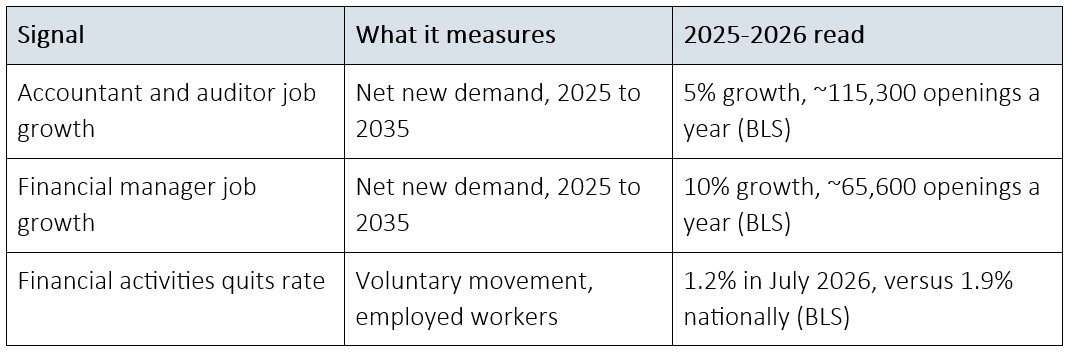
A field can carry strong demand and a reluctant labor pool at the same time, and finance is doing both. The enrollment recovery is real. Total postsecondary accounting enrollment reached 313,397 students in 2025, up from 293,759 the year before, and graduate-level accounting enrollment rose for the first time since 2019. None of it is in the workforce yet, though. The people available to hire this year come from a graduating class that shrank 6.6%, to 55,152, in the most recent completed cycle, and that's the group a 2026 search is actually drawing on.
One thing most companies get backwards here: treating the enrollment recovery as a reason to wait. A pipeline correcting itself over several years doesn't help a search that needs to close this year. The gap matters most at the executive level, where there is no larger junior bench to pull up from. A company sourcing on relationships built ahead of need is still drawing from the same shrunken graduating class, just earlier and with less competition for attention.
Three Signs Your Finance Search Is Running on the Wrong Approach
Three signals say a search is running on volume instead of precision. None of them is simply "it's taking a while." Each one shows up early, often before a hiring manager would think to ask whether the approach is the problem rather than the market.
- Applicant count is high, but finalists are thin. A posting can generate real volume in a high-opening, low-quits market and still produce nobody worth a second interview, because volume measures reach, not fit.
- Interviews keep getting rescheduled for internal decisions. A slate stalling on process rather than candidates often signals requirements that were never surfaced up front, exactly what an intake step is built to catch before sourcing starts.
- A strong candidate takes another offer mid-process. In a field where finance professionals aren't quitting at a normal rate, the ones who do move get several offers fast. A search without a clear owner pushing the next step forward loses to whichever process moves quicker.
Automate the calendar reminders that a step is due. Never automate the decision to move on a finalist. That call still needs a person weighing fit against speed, not a scheduling rule, and it's one piece of the broader hiring discipline a tight market makes non-negotiable.
Three Numbers That Show Whether Your Search Is Actually Working
Three numbers, read together, tell a finance leader whether a search is on track. They are weeks open and how many finalists reach a second interview. A third is how many finalists came from outside an active application, versus applying on their own. Track a baseline on all three before assuming the market is the problem.
If weeks open keeps climbing but finalist quality holds, that's a genuinely tight market, and the fix is patience plus continued outreach, not a process change. If weeks open is climbing and finalists are thin too, that's a sourcing problem: the search is drawing only from the fraction of the pool that applies on its own. If finalists look strong but keep declining offers, that points to speed, since a slate that good in a low-quits market won't wait through a slow internal process.
Track all three from the day a role opens, not from the day someone flags that the search feels stalled. Waiting to count until a search already feels long means measuring the problem a month after it started.
Pull your last open search's numbers right now: weeks open, finalists who reached a second interview, and how many came from outside an application. If weeks are climbing but finalists are thin too, that's sourcing, not the market. Curious what a precision-first search would surface for your open role? Let's talk it through.
Frequently Asked Questions
What does "time to fill" actually measure in a finance search?
Time to fill measures the days between a role opening and an accepted offer. That conflates two different problems: how long it takes to find qualified candidates, and how long it takes a company to decide among them. Reading it as one number hides which half is actually slow.
When should a company start a finance leadership search relative to the role opening?
Before the seat is fully vacant, ideally. Passive candidates in a low-quits market take weeks to identify and approach, even when they're open to a conversation. Waiting until the role is empty adds that lead time on top of an already tight pool.
Who should decide between a volume agency and a direct-hire search?
The person who will own the seat's output, not a function optimizing for the lowest fee, should own the choice of search approach. The cost of a wrong finance hire compounds well past whatever the search itself cost.
What counts as a normal slate size for a controller or CFO search?
A small, qualified slate, often a handful of finalists rather than a dozen candidates, is normal for a senior finance role. A large slate in a tight market is more often a sign of loose screening than strong sourcing.
What actually breaks when internal reviewers say they're "too busy" to move a search along?
Usually not aggregate capacity. It's that no single person owns turning a strong slate into a decision inside a set window, so review time expands to fill whatever calendar gap exists. Naming one decision-maker with a deadline, rather than routing a slate to a group, is what closes this specific gap.
What Changes When You Stop Competing on Job-Board Volume
A 5% growth number and 115,300 annual openings describe real demand, not a market that hires itself. The companies whose searches close in weeks, not months, read the market differently. They treat the low quits rate and the still-recovering graduate pipeline as the actual constraint, not the growth headline.
Sourcing wide and hoping fit shows up eventually is a bet against a market that has already said, in its own numbers, that it won't cooperate. Setting up a precision-first search is a decision only the hiring company can make. Running it is what Journey does. If your last finance search ran longer than it should have, reach out before the next one goes out the same way.
References
- "Accountants and Auditors." Occupational Outlook Handbook, U.S. Bureau of Labor Statistics. Published undated (continuously updated program page). Verified live September 17, 2026.
- "Financial Managers." Occupational Outlook Handbook, U.S. Bureau of Labor Statistics. Published undated (continuously updated program page). Verified live September 17, 2026.
- "Job Openings and Labor Turnover Summary." U.S. Bureau of Labor Statistics. Published September 1, 2026 (July 2026 data). Verified live September 17, 2026.
- "Table 4. Quits levels and rates by industry and region, seasonally adjusted." U.S. Bureau of Labor Statistics. Published September 1, 2026 (July 2026 data). Verified live September 17, 2026.
- "Table 1. Job openings levels and rates by industry and region, seasonally adjusted." U.S. Bureau of Labor Statistics. Published September 1, 2026 (July 2026 data). Verified live September 17, 2026.
- "The Employment Situation - August 2026." U.S. Bureau of Labor Statistics. Published September 4, 2026. Verified live September 17, 2026.
- "U.S. Accounting Undergraduate Enrollment Rises for Third Straight Year." AICPA & CIMA. Published January 20, 2026. Verified live September 17, 2026.
- "Accounting Firms Report Strong Hiring Outlook, AICPA Report Finds." AICPA & CIMA. Published October 27, 2025. Verified live September 17, 2026.
