
The short answer: Finance pay growth is cooling, but job switchers still earned 5.0% raises in August 2026, against 3.6% for stayers, per the Atlanta Fed. Set the band at the mover rate, write the role around decisions instead of tasks, and record why finalists decline. With accountants and auditors at 2.0% unemployment, precision beats speed.
Written for finance and accounting leaders, such as CFOs and controllers, who own an open finance seat, not for professionals weighing a move; that side runs on different mechanics.
In this guide:
- Why Is Pay Growth Cooling When Finance Talent Is Scarce?
- How Do You Define a Finance Role Precisely?
- Where Your Offer Sits Against the Market
- When to Rewrite the Role Before You Post It
- Three Numbers That Show the Search Is Working
- Frequently Asked Questions
- Pay Is Cooling. Precision Is the Advantage.
- References
Accountants and auditors ran a 2.0% unemployment rate in 2025, less than half the 4.3% rate for all workers, per the Bureau of Labor Statistics. Yet salary growth is not surging. Wages and salaries in financial activities rose 3.1% in the year to June 2026, down from 4.3% a year earlier, per the same agency. A tight candidate pool and cooling salary growth rarely arrive together. For a leader whose hiring intent is already strong, that combination is the opening.
Read the pay data closely and a second gap appears. The Atlanta Fed's tracker shows job stayers getting 3.6% raises in August 2026, while job switchers got 5.0%. A band built from the annual raise pool sits 1.4 points under what the typical mover received. The candidate sees that gap. Your budget sheet may not.
This guide covers why pay is cooling while skilled finance talent stays scarce, how to define a role precisely, and where your offer sits against the market. It then shows when to rewrite a role before posting it and which three numbers prove the search is working. It draws on public labor data and on how Journey Search Partners scopes a direct-hire search.
Why Is Pay Growth Cooling When Finance Talent Is Scarce?
Finance salary growth is cooling even though skilled finance people are scarce. Wages and salaries in financial activities rose 3.1% in the year to June 2026, per the Bureau of Labor Statistics, down from 4.3% a year earlier. The scarcity has not gone away. It has moved to the moment someone changes jobs.
Cooling is not collapsing, because across private industry wages and salaries rose 3.1% over the same year and management, business and financial occupations rose 3.0%. Benefits grew faster, at 3.8%, led by health benefits at 6.0%. Total pay is moving faster than salary alone.
The scarcity is real, because in 2025 BLS counted about 35,000 unemployed accountants and auditors against a labor force of roughly 1.8 million. BLS notes that its 2025 annual figures are 11-month averages because October data was not collected, so compare them with other years carefully. The candidate pool is genuinely tight, because almost everyone qualified already has a job.
How Do You Define a Finance Role Precisely?
This market rewards precise specs. A precise finance spec rests on three things: the decisions the seat owns, the pay the market will clear, and the proof a candidate must show. Pay decides who answers the call. Job switchers earned 5.0% raises in August 2026, per the Atlanta Fed, against 3.6% for stayers.
Precision is also where Journey Search Partners starts every search internally. The firm names it P — Precision, the first step of its PATH process, and defines it in its own words as work that is “highly intentional... we target with surgical precision, aligning technical skills, leadership style, and cultural fit.” The same standard applies to the spec itself: get the three parts right before the role ever posts.
Each of the three parts changes who you meet in the first week, so work through them in order.
1. Price the seat at the mover rate
Your raise pool measures people who stayed, but a candidate weighing your offer is a mover. The Atlanta Fed's tracker compares the same person's hourly pay twelve months apart, so a mover's figure spans a negotiation and a stayer's spans a review cycle. Movers reached 5.0% in August, up from 4.4% in July, while stayers held at 3.6%.
On the BLS median wage for accountants and auditors, $83,680, that 1.4-point gap is worth about $1,170 a year. The tracker covers all workers, not only accountants, so treat the figure as a measure of scale. A direct hire becomes permanent headcount, so a band set from your merit budget stays short through every review cycle after it. Plan finance pay for a new hire from the mover rate.
2. Write the spec around decisions, not tasks
Most finance specs still list tasks: reconciliation, close support, routine reporting. BLS expects the automation of routine work such as data entry to make accountants' advisory and analytical duties more prominent. So a strong spec tests digital fluency by asking what the person will decide with the output. When screening candidates, ask what they did with the output of automated systems: what they caught, what they changed and what they recommended because of it.
Finance teams are aiming AI at productivity more than at judgment. Gartner's March 2026 survey of 204 finance leaders found that 45% of AI investments lean toward productivity and 20% toward decision quality. AICPA and CIMA found that only 8% of 1,446 finance leaders call their organization very well prepared for AI. That leaves judgment on tool output as the scarce skill.
This is where the intake conversation earns its time. Journey Search Partners begins a search by discussing the specific details of the role with the hiring leader and getting to know the team, company culture and values — the P — Precision step of the firm's PATH process in practice.
3. Give the passive candidate a reason to move
A candidate who is not looking weighs pay and scope together. If your offer is today's job plus 3%, the answer is usually no. Journey's guidance on passive candidates says they need persuading to leave. It adds that the opportunity must offer more than their current role, such as room to grow, more responsibility or a shorter commute. Pay opens the door. Scope closes it.
Where Your Offer Sits Against the Market
Set a new hire's band against what movers earn, not against your merit budget. In August 2026, movers received 5.0% raises and stayers 3.6%, per the Atlanta Fed. An offer priced from the stayer figure starts 1.4 points behind before the candidate has asked a question.
The table below sets five public pay measures side by side, and each comes from a different survey, so compare within a measure rather than subtracting across rows.
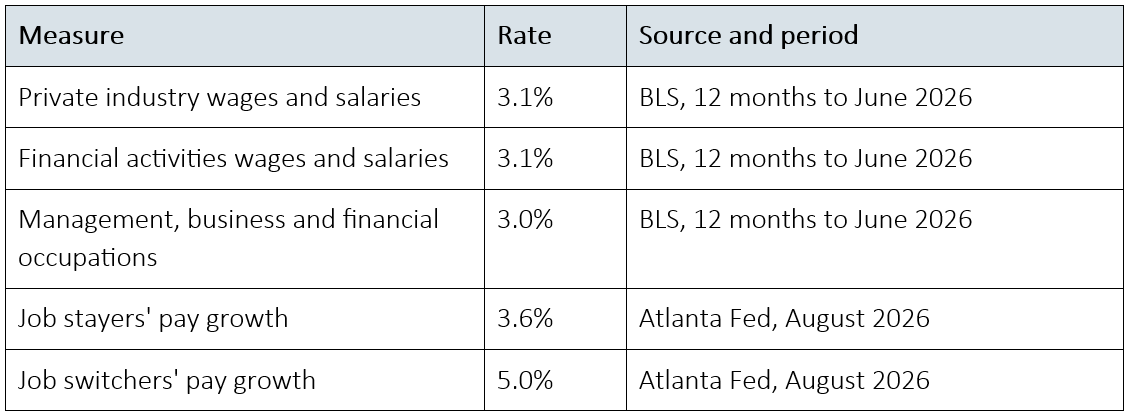
Why the gap appears. A stayer's raise is set inside the employer's own review cycle. A mover's raise is set by a new employer competing for that person. The tracker compares the same person twelve months apart, so it captures both.
The play most firms miss. Decide the band before the first interview and write it into the spec. A band set at the offer stage is set under pressure.
Movers got 5.0% raises in August; stayers got 3.6%. Open the band on your last finance offer and check which number it tracks. If it sits nearer your raise pool, you bid against the wrong figure. Not sure where yours lands? Talk it through.
When to Rewrite the Role Before You Post It
Rewrite the role before you post it if it fails any of three tests, because a posting cannot fix a spec. With accountants and auditors at 2.0% unemployment in 2025, per BLS, a vague posting reaches few people who are free to answer it. The three tests below decide whether the posting is ready.
- The spec is a task list. If the top lines are reconciliation and routine reporting, name the decisions instead. Ask for one example of output a candidate caught, changed or escalated.
- The band sits under the mover rate. Compare it with the August 2026 mover figure of 5.0% before you post, not after the first decline.
- You cannot pitch the role in one sentence. If the pitch needs a paragraph, the role is not yet defined.
Automate the timing, never the human moment. Software can log stage dates and remind you when a finalist has waited too long, but it cannot judge whether a candidate's read of a variance is sound. That call needs a person who has made it before.
The scope of that rule is finance hiring decisions, and Gartner's 45% and 20% split describes AI budgets inside finance functions, not hiring practice.
Three Numbers That Show the Search Is Working
Track three numbers on every finance search. First, the share of finalists who decline, and why. Second, the days between the final interview and the offer. Third, how a new hire's first 90 days compare with the decisions the spec named. Together they show whether the problem is price, pace or fit.
Read them as a set, because each combination points to a different fix. If declines cite pay and offers go out quickly, price is the problem. Rebuild the band from the mover rate. If declines cite scope and pay is in range, the spec is the problem. The role reads smaller than the candidate's current job. If offers are accepted but the 90-day review misses the named decisions, the spec described tasks and the search selected for them. Fix the spec, not the hire.
The days between the final interview and the offer are the one place speed belongs. A slow offer gives a candidate who is not looking time to reconsider, while every other stage should take the time fit needs.
Build the three numbers into your hiring plan before the role posts. There is no public benchmark for these three numbers, so this guide does not offer one. Use your last three finance searches as the baseline, then compare each new search against it. A baseline built from your own searches beats a borrowed average.
If your last finance offer was declined, pull the reason from the notes. Pay points to price; “not enough scope” points to the spec. A decline with no reason on record means the search taught you nothing. Stuck reading yours? Ask what we'd check.
Frequently Asked Questions
What is the median salary for accountants and auditors?
BLS reports a median annual wage of $83,680 for accountants and auditors in May 2025, against $50,980 for all workers. The median means half earn more and half earn less. Pay differs by industry: the median was $93,290 in finance and insurance and $81,490 in accounting, tax preparation, bookkeeping and payroll services. Check your local market before you set a band.
Why are real wages falling if pay is still rising?
Prices are rising faster than pay. BLS reports that private-industry wages and salaries rose 3.1% in the year to June 2026, while inflation-adjusted wages fell 0.4%. A staying employee can gain dollars and still lose buying power. That gives a candidate a reason to compare offers, even in a cooling market.
Which finance roles are hardest to fill?
By 2025 unemployment rates, no rung looks loose. Financial managers and accountants and auditors both ran 2.0%, financial and investment analysts 1.7%, and bookkeeping, accounting and auditing clerks 2.3%, against 4.3% for all workers. Unemployment counts people who lost a job in that occupation, so it shows availability, not difficulty. Treat every level as a search that needs a precise spec.
Who should set the pay band for a finance hire, the CFO or HR?
The leader who owns the seat should own the band, with HR supplying market data and checking internal equity. Splitting the decision leaves nobody able to move on a strong candidate in the same week. Settle who can approve an above-band offer before the search opens.
What does digital fluency mean for an accountant?
Digital fluency means checking, challenging and acting on what automated systems produce, not only running them. In the AICPA and CIMA survey of 1,446 finance leaders and managers, 56% named generative AI the most prominent skills gap. Separately, 33% cited gaps in communication, influencing and critical thinking. The clearest test is a candidate who can describe a time they overrode a tool's output and why.
Pay Is Cooling. Precision Is the Advantage.
Finance salaries are rising 3.1% while movers earn 5.0% raises, and accountants and auditors sit at 2.0% unemployment. Those numbers reward a search that prices the seat at the mover rate, writes the role around decisions and logs why finalists decline. Speed matters at one point only: the days between final interview and offer.
The seat, the band and the final call are yours. Scoping the role with you, reaching people who are not looking and screening for fit are what Journey Search Partners runs on accounting and finance searches. Everyone else is chasing the same candidates, and the edge is defining the role more precisely. If a finance seat is in your hiring plan, tell us what's open before it posts.
References
- "Employment Cost Index Summary, June 2026." U.S. Bureau of Labor Statistics. Published July 31, 2026. Verified live 2026-09-28.
- "Table 9. Wages and salaries: Employment Cost Index for private industry workers, by occupational group and industry." U.S. Bureau of Labor Statistics. Published July 31, 2026. Verified live 2026-09-28.
- "Table 25b. Unemployment levels and rates by detailed occupation, 2025 annual averages." U.S. Bureau of Labor Statistics, Current Population Survey. Published undated (2025 annual averages). Verified live 2026-09-28.
- "Accountants and Auditors." U.S. Bureau of Labor Statistics, Occupational Outlook Handbook. Published August 27, 2026 (last modified; wage data are May 2025). Verified live 2026-09-28.
- "Wage Growth Tracker." Federal Reserve Bank of Atlanta, August 2026 data. Published September 10, 2026. Verified live 2026-09-28.
- "Gartner Survey Shows 45% of CFOs Say Their AI Investments Lean Toward Productivity, While 20% Say These Investments Lean Toward Decision Quality." Gartner, Inc. Published July 20, 2026. Verified live 2026-09-28.
- "AI Transformation Opens Door for Finance Professionals to Build Future-Ready Skills, AICPA and CIMA survey find." AICPA & CIMA. Published December 17, 2025. Verified live 2026-09-28.
