
The short answer: A great passive finance candidate proves they are ready for your seat, not just that their resume is strong. Test three things: a decision they owned that went wrong, fit with the work your seat needs, and their reason to move. Strong resumes are the norm. Accountants ran 2.0% unemployment in 2025, per BLS.
Written for CFOs, controllers and the executives who own a finance hire, on the employer side of the search; the candidate's side of a recruiter's call is a separate subject with its own guide.
In this guide:
- Why do strong finance resumes hide such different candidates?
- How do you test whether a passive finance candidate is actually ready?
- What a Polished Finance Track Record Doesn't Prove
- Three Moments That Decide Whether You Land Them
- Three Numbers That Tell You the Evaluation Worked
- Frequently Asked Questions
- Readiness Is Proven Under Questioning, Not Read Off a Page
- References
Finance and insurance workers rarely quit. Their monthly quits rate was 1.0% in August 2026, less than half the 2.1% across all private industry, per the Bureau of Labor Statistics. That changes who you are evaluating: the best candidate for your controller or finance director seat is most likely employed and staying put. They will look polished on paper, so the real question is whether they are ready for the seat you have. Readiness is the test.
Our own search process starts from that premise. Precision, the first letter of our PATH search process, reads: "Our searches are highly intentional. We don't cast wide nets, we target with surgical precision, aligning technical skills, leadership style, and cultural fit." In practice, how we find them means picking out a select few professionals, sometimes as few as one. Then "we screen each individual to see how their personality, values, and leadership style align with your existing team." The resume gets them on the list. It never decides.
This guide covers why similar resumes hide different candidates, how to test readiness and what a track record doesn't prove. It ends with the moments that decide a yes and the numbers that show it worked, built on the PATH process we run on every search.
Why do strong finance resumes hide such different candidates?
Strong finance resumes look alike because nearly every experienced accountant is employed. Accountants and auditors ran 2.0% unemployment in 2025, against 4.3% for all workers, per BLS survey data. When almost every candidate is working, a clean resume tells you who stayed employed, not who fits your seat. Fit is a separate question.
The pattern holds up the ladder. The same BLS table puts financial managers at 2.0% unemployment and financial and investment analysts at 1.7%. These are eleven-month averages, because October 2025 went uncollected during the federal shutdown. Of roughly 1.8 million accountants and auditors in the labor force, about 35,000 were unemployed. Almost everyone you could hire already has a job.
Two controller candidates can show the same close calendar, ERP and clean audits, yet one spent five years running a process someone else built while the other built one under pressure. The page cannot show the difference, but a conversation can.
There is a second reason hiring leaders underestimate: passive candidates usually haven't rehearsed. An active job seeker may have told their story a dozen times this month, while a passive candidate tends to answer the way they actually think. That works in your favor, but only if your questions go past the rehearsed answer.
How do you test whether a passive finance candidate is actually ready?
Ask what a resume cannot answer: a decision that went wrong, the work your seat needs, and why they would move. In an AICPA and CIMA survey of 1,446 finance leaders and managers, 33% named communication, influencing and critical thinking as skills gaps. None of those shows up on a resume.
The same survey found 32% citing business partnering as a gap, alongside technical gaps such as AI. Judgment-type skills are scarce, and a resume can't show them. Three components test for them.
1. Ask for the decision that went wrong
Skip the success stories and ask a finalist to walk you through one call they owned that didn't work: a forecast that missed, a control that failed, a migration that slipped. Then ask what they changed afterward. A resume-ready candidate gives a smooth answer with no friction in it. An actually-ready candidate gives you the numbers and names their own part without prompting. Two success stories and no setbacks tested confidence, not fit.
2. Test against the seat, not the title
Describe the seat honestly, then ask how they would split their week in it. Honesty is the fourth letter of PATH, and we hold ourselves to its exact wording: "The greatest, most enduring successes are built on honest work. As your partner, we hold ourselves to the highest ethical standards in everything we do." So tell the candidate the unglamorous truth: the messy close, the reporting system nobody likes, the owner who wants a weekly call. A candidate who starts asking how to fix it is telling you more than a reference check will. One who only asks about the title is telling you something too.
3. Ask why they would move, then debrief the same day
A passive candidate needs a reason to leave a job they are not trying to leave. Ask directly what would have to be true for a move to make sense, write down the answer, then debrief every interview the same day, with every interviewer, against the same three tests. This is where a disciplined intake call pays off, because everyone agreed on the seat first. A same-day debrief catches the gap between confident and specific.
Pull your notes on your last two finance finalists. Find what each said about a decision that went badly. No number and no change afterward means you measured polish, which every candidate here has. Not sure what would have caught it? Compare notes with us →
What a Polished Finance Track Record Doesn't Prove
A polished track record proves success in their last setting. It doesn't prove readiness for yours. The finance job is changing fast. In the AICPA and CIMA survey, 56% named generative AI the biggest skills gap, and only 8% said their organization was very well prepared for AI.
The table below separates what a resume can show from what only a conversation can.
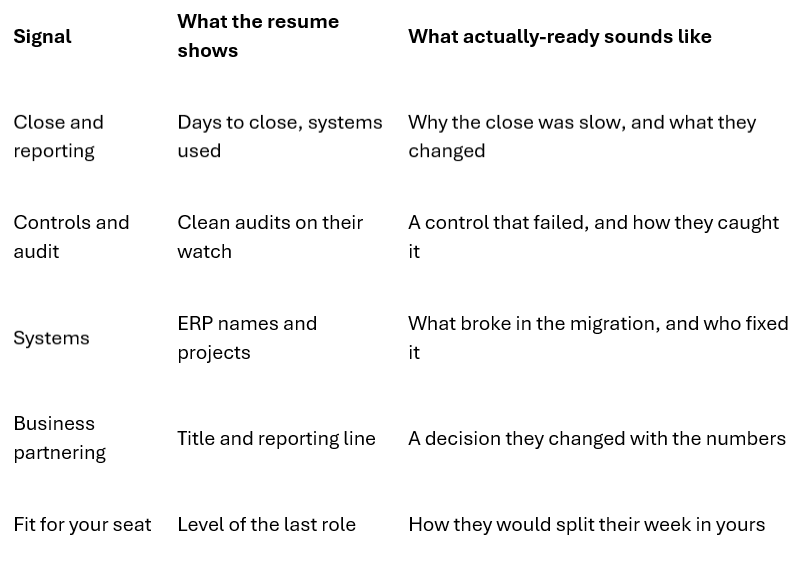
Two notes explain why this works. First, each answer in the right-hand column invites a second question about specifics, which polish can't survive. Second, it moves the interview from what the candidate did to how they think, the part the survey says is scarce. Priorities are shifting, too: 46% of respondents ranked IT and technology capabilities as their top priority, up from 20% in 2021. BLS makes the same point in its outlook for the profession, noting that "the automation of routine tasks, such as data entry, will instead make accountants' advisory and analytical duties more prominent." A resume describes the old job.
The offensive play is where you look. Search for the mix of work your seat needs, not the title. A controller at a smaller company can own work that a larger company splits across several roles, which may be exactly the hands-on range your seat needs. That is Access, the second letter of PATH: "Our reach goes far beyond standard resumes and public job boards. Through our deep networks and long-standing relationships, we introduce you to leaders before they ever hit the open market." Look for the work, not the title.
Three Moments That Decide Whether You Land Them
Passive finance candidates are won or lost at three moments. You define the seat, set the dates and make the case for moving. BLS projects about 115,300 openings a year for accountants and auditors and about 65,600 for financial managers through 2035. With so few people out of work, most hires come from people with jobs.
- Define the seat before the first outreach. Agree on the split of strategic and hands-on work, the systems they will inherit and the one result that matters in year one. A passive candidate asks about all three on the first call, and a vague answer ends it.
- Set the debrief and decision dates before the first interview. Speed comes from never waiting on a calendar, not from rushing the evaluation.
- Make the case for moving, in person. Job switchers' pay grows faster, but not by enough to move a content person on its own. The Federal Reserve Bank of Atlanta's Wage Growth Tracker put median wage growth at 4.7% for switchers and 3.4% for stayers in September 2026. The hiring leader has to give a reason beyond money.
The rule behind all three is simple: automate the timing, never the human moment. Calendar holds and reminders can run on their own, but the call that asks a happy, employed controller to change jobs should come from the person they would work for. Timing, the third letter of PATH, puts it this way: "We work with urgency to find you the right talent exactly when you need it. Our searches move quickly because we know the right person at the wrong time is the wrong hire."
Three Numbers That Tell You the Evaluation Worked
Three numbers show whether you found an actually-ready candidate. Count finalists who pass the hard question, offers accepted, and year-one results. Year-one results are an early read, not a verdict. BLS puts median tenure at 4.9 years in management and professional roles.
Pull the same three numbers for your last finance search first, so you have a baseline. Then track them as a set:
- Finalists who pass the hard question. Count how many gave a specific, owned answer about a decision that went wrong. If none did, the slate was built for the resume, not the seat.
- Offer acceptance. Count accepted offers against offers made, and record the reason for each decline. A passive candidate's no tells you whether the case for moving landed.
- Year-one results. Agree the one result that matters before the offer, then check it at 90 days and 12 months. A miss at 90 days is a signal to act on, not a reason to wait.
Read the combinations, because each points to a different fix. If finalists pass the hard question but decline offers, the evaluation worked and the case for moving did not: look at scope, pay and the pitch. If they accept but miss the year-one result, you tested the resume instead of the seat. Our guides on a controller or VP and the controller standard help define it. That fix starts before outreach.
If your last finance hire passed every interview and still missed the result you hired for, look first at how the seat was defined. Write that one result down before the next search opens. Want a second read on it? Talk it through →
Frequently Asked Questions
What is a passive candidate in recruiting?
A passive candidate is employed and not applying for jobs, but open to the right move. In finance, nearly every experienced candidate is employed; accountants ran 2.0% unemployment. You usually reach them through direct outreach and referrals, not job postings.
Are passive candidates better than active candidates?
Not automatically. An active candidate can be an excellent hire, and a passive one can be the wrong fit. Passive candidates usually haven't rehearsed, so a well-built interview can get a more honest read.
When should you bring in a recruiter for a finance search?
Bring one in when the right person is not on the market, or when your outreach produces applicants but not finalists. A search firm earns its place by reaching people who aren't looking.
Who should interview a finance leadership candidate?
The executive the role reports to should run the deciding interview. Add one peer who will rely on the role's numbers. Keep the panel small and agree the readiness questions in advance.
What do you say to a passive candidate on the first call?
Lead with the seat, not the company pitch, and say what the role owns, the problem it solves this year and why you thought of them. Then ask what would have to be true for a move to make sense, and listen.
Readiness Is Proven Under Questioning, Not Read Off a Page
A strong resume is the default in finance, not the differentiator. With a 1.0% monthly quits rate in finance and insurance and 2.0% unemployment for accountants, the companies that hire well do three things. They define the seat first, ask the question a rehearsed answer can't survive, and make a personal case for moving. Then they move.
Turn the hard question on your own process. If you can name the decision your last finance finalist got wrong and what they learned, your evaluation is working. If you can't, the gap is in the interview, not the talent pool. The judgment about who fits your team is yours, and it should be. Finding the people who are not looking, and testing them before they reach you, is what we do through direct hire and accounting and finance search at Journey Search Partners. If your next finance seat matters too much to fill from whoever applies, connect with our recruiters.
References
- "Table 4. Quits levels and rates by industry and region, seasonally adjusted." U.S. Bureau of Labor Statistics, Job Openings and Labor Turnover Survey. Published 2026-09-29. Verified live 2026-10-13.
- "25b. Unemployment levels and rates by detailed occupation, 2025 annual averages." U.S. Bureau of Labor Statistics, Current Population Survey. Published undated (2025 annual averages). Verified live 2026-10-13.
- "AI Transformation Opens Door for Finance Professionals to Build Future-Ready Skills, AICPA and CIMA survey find." AICPA and CIMA. Published 2025-12-17. Verified live 2026-10-13.
- "Accountants and Auditors: Occupational Outlook Handbook." U.S. Bureau of Labor Statistics. Published 2026-08-27. Verified live 2026-10-13.
- "Financial Managers: Occupational Outlook Handbook." U.S. Bureau of Labor Statistics. Published 2026-08-27. Verified live 2026-10-13.
- "Wage Growth Tracker." Federal Reserve Bank of Atlanta. Published 2026-10-08. Verified live 2026-10-13.
- "Employee Tenure in January 2026." U.S. Bureau of Labor Statistics. Published 2026-09-24. Verified live 2026-10-13.
