
The direct answer: HR and talent acquisition hiring in 2026 comes down to three shifts. Hiring plans have gotten leaner as scrutiny replaces urgency. AI has already forced some employers to rehire for roles they thought automation could handle. And internal mobility has become a first resort rather than a fallback, with 72% of organizations now calling it more important than ever.
Written for HR and talent acquisition leaders on the employer side of the hiring equation, filling your own open seats rather than looking for one, which runs on different mechanics we cover separately.
In this guide:
- Why Are HR and Talent Acquisition Hiring Plans Getting Leaner?
- How Should HR Leaders Adjust Their Process for Fewer, Higher-Stakes Requisitions?
- What Actually Works When Hiring Plans Tighten?
- When Should HR Move on Internal Mobility Versus an External Search?
- What Three Numbers Tell You Whether Your Hiring Plan Is Working?
- Frequently Asked Questions
- The Standard Is Getting Higher, Not Just Tighter
- References
Professional and business services hiring fell by 188,000 in July 2026. It was the only sector move the Bureau of Labor Statistics flagged as significant that month. Total U.S. job openings still held near 7.3 million. Hires held near 5.1 million, a 3.2% rate against a 4.4% openings rate. That sector is where recruiting, consulting and technical-services roles sit, and it tends to move first. The market did not collapse. It got pickier.
This guide covers what changed in hiring plans this year, what AI got wrong before employers started correcting it, and where internal mobility now sits in the sequence. All three shifts are already visible in the labor-market data HR and TA leaders track every month.
Why Are HR and Talent Acquisition Hiring Plans Getting Leaner?
Hiring plans are getting leaner because approval has gotten more expensive, not because demand disappeared. Every open requisition now competes for a smaller number of yeses, and each yes has to survive more scrutiny before it clears. The result is fewer roles moving, and the roles that do move take longer to close.
SHRM's 2026 hiring-trends coverage names the mechanism directly. Matt Charney, principal analyst at Kyle & Co, told SHRM that benchmarks for days-to-fill and cost-per-hire will keep rising. Not from inefficiency, he said, but from heightened selectivity: every approved hire now has to be business-critical, with longer approval cycles and more scrutiny at the offer stage. Gartner's Jamie Kohn described the same shift from the other side of the table: companies are hyper-focused on efficiency, making sure that if they hire, they hire for the right role. Fewer roles, higher stakes.
This is the condition a genuinely targeted search is built for, rather than an accident it has to work around. When hiring plans tighten, a targeted search stops being a nice-to-have. It becomes the only kind of search that clears the approval a leaner plan demands, especially inside our direct-hire model, where there's no volume fallback to lean on.
Pull your last five approved requisitions and check how many skipped the internal-mobility look and went straight to an external post. If most did, that's a sequencing problem, not a candidate one. Curious what a precision search looks like? Talk it through with us →
How Should HR Leaders Adjust Their Process for Fewer, Higher-Stakes Requisitions?
Adjusting to fewer, higher-stakes requisitions comes down to three foundations. Write a sharper brief before the search opens. Widen where you look for the person, not how many resumes you collect. And protect the timeline without cutting the diligence that makes the hire stick.
1. Write the brief the approval actually needs
Most job briefs still describe the seat, not the gap. A tighter approval process does not reward a longer requirement list. It rewards a shorter one that names the single thing the hire has to fix in the first 90 days. Here is the counterintuitive part: cutting requirements usually adds candidates, not removes them. A long list screens out someone strong on the thing that matters and weak on something that does not. This year's hiring guide walks through what a tighter brief looks like in practice.
2. Search where the market isn't advertising
Finding that person is built around a specific bet: the strongest candidates for a narrowly defined role are usually employed, not applying, and reachable only through relationships built well before the search opened. In a leaner-plan year that bet matters more, not less. Fewer approved roles means each one has to land on the first attempt. The candidates least likely to apply to a posting are often the ones best suited to a role built around a specific gap, which is what direct hire means in practice rather than in theory.
3. Keep urgency attached to process, never standing alone
The T in PATH, Timing, states the discipline plainly: "we work with urgency to find you the right talent exactly when you need it. Our searches move quickly because we know the right person at the wrong time is the wrong hire." Speed that isn't attached to that discipline is not a feature in a leaner-plan year. It's a warning sign. A fast wrong hire now costs more to unwind than it did when a second try was cheap to approve.
What Actually Works When Hiring Plans Tighten?
What works when hiring plans tighten is matching the search method to how scarce the candidate actually is, not to how urgent the seat feels. A role competing for a widely available skill set can still run on volume. A role competing for someone not actively looking cannot, no matter how much the open seat is costing you.
The gap between organizations built for this and organizations that are not is measurable, even without a single client name attached to it.
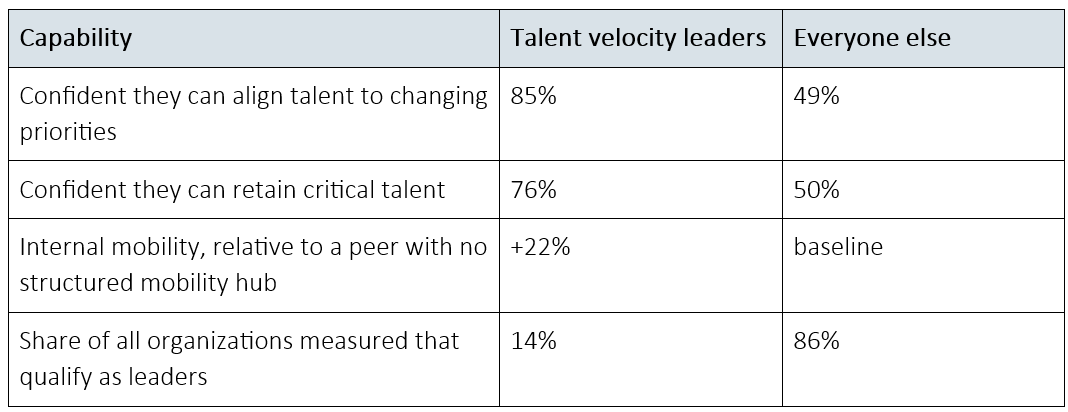
The gap is not access to better people. It's a structural habit. Leaders look inside the company for the next fit before opening an external search. Only 14% of the organizations LinkedIn measured have built that habit well enough to show up as leaders in its own data. Just 30% of organizations have moved to skills-based workforce planning, the discipline that makes an internal match visible in the first place. Gartner also found that organizations rated highly on skills-readiness are 3.8 times more likely to hit their workforce goals than those that are not. Precision search and internal mobility are not competing approaches. They answer different questions: whether the right person is already inside the company, and if not, how narrowly to look outside it.
The offensive play most HR teams miss is sequencing the two rather than choosing between them. Run the internal-mobility check first, on a fixed clock, and open an external search the moment that clock runs out rather than after another round of internal debate. The clock protects the timeline. The sequence protects the fit, which is what to expect once that clock runs out.
Ask your HR team one question: of the roles filled this year, how many started with an internal-mobility check on a real clock? If the honest answer is "we don't track that," the tracking gap is costing you more than the search would. Compare notes with us →
When Should HR Move on Internal Mobility Versus an External Search?
Move on internal mobility first when the gap is a stretch, not a specialty, and someone inside has already shown the adjacent skill. Move to an external search immediately when the role needs a capability nobody on the team has demonstrated. Internal readiness cannot be manufactured on the clock a leaner plan gives you.
- Set the internal-mobility clock before you post anything. Give it a real number of business days, not "let's see who raises a hand," and hold to it.
- Score internal candidates against the same gap you wrote in the brief, not against their tenure or their manager's opinion of them. Tenure answers a different question than fit does.
- Open the external search the day the clock expires, not the day someone finally admits the internal answer isn't there. The delay between those two moments is where a leaner plan turns a hard hire into a late one, and how to expedite hiring from that point on is its own discipline.
The one thing not to compress is the human decision at the center of it: who actually reviews the internal candidate and signs off. Compress the clock around that decision. Never compress the decision itself.
What Three Numbers Tell You Whether Your Hiring Plan Is Working?
Three numbers tell you whether a leaner hiring plan is working. Track requisition-to-approval time. Track the share of open roles filled from inside the company. Track time-to-fill on the roles that go external. Watch them together, because any one of them alone can look fine while the other two are quietly failing.
If requisition-to-approval time is short but internal-fill share is low, the plan is approving roles faster than the company is finding people for them inside it. The fix is upstream, in the internal-mobility habit, not in the search. If internal-fill share is healthy but external time-to-fill keeps stretching past what LinkedIn's own leader benchmark implies it should, the roles that do go outside are the hardest ones. They deserve a search built for scarcity rather than volume, which is a different conversation than the one a job board answers.
Start pulling these three numbers before you change anything about how you hire, not after. A number you only start tracking once something already feels broken tells you nothing about whether the fix worked.
If the strain is showing up inside HR's own capacity as much as in the roles you're trying to fill, that's worth reading alongside this guide. And if the seat you're stuck on sits inside the HR or people function specifically, our HR search practice is built around exactly that kind of scarcity.
If you can't say, right now, what your average internal-mobility fill rate is, you're not behind LinkedIn's 22% benchmark. You're not measuring against it at all. Want a second read on what to track first? Ask us what we'd look at first →
Frequently Asked Questions
What does a "leaner hiring plan" actually mean?
It means fewer requisitions get approved, and the ones that do face more scrutiny before and after the offer stage. It is not a hiring freeze. Roles are still open. They just have to justify themselves harder, and the search behind them has less room for a mis-hire.
Why did some companies end up rehiring for roles they had automated?
Because the automation was tested against normal conditions and then asked to handle the edge cases too. Gartner's own July 2026 survey found 95% of organizations have adopted AI in some form, but only 20% call it transformational so far. Gartner's Jamie Kohn has called 2026 the year of the AI reality check. Several employers overestimated what a role could absorb. They hit the parts of the job that don't automate well, and rehired to cover them.
Who should own the decision to check internal mobility before opening an external search?
The hiring manager and HR should own it jointly, on a fixed clock, not as an open-ended courtesy. When nobody owns the internal check specifically, it either never happens or drags on long enough to erase the time it was supposed to save.
Is internal mobility always cheaper than an external search?
Not always, but it is usually faster to reach a decision, since the person is already known. It stops being cheaper the moment a company promotes someone into a gap they aren't ready for and has to backfill the role they left. That's why scoring the fit matters more than scoring the tenure.
What is a reasonable internal-fill rate to aim for in HR and TA roles specifically?
There is no single published benchmark specific to HR and TA seats. The closest public reference point is LinkedIn's finding that organizations with a structured internal-mobility hub see 22% higher internal mobility than those without one. Treat it as a lift to calibrate against, not a target to hit exactly.
The Standard Is Getting Higher, Not Just Tighter
Hiring in 2026 did not get harder because there are fewer people. It got harder because the approval bar rose, because AI's limits showed up faster than expected, and because the best-prepared employers built the internal-mobility habit before they needed it. The three numbers above prove it wasn't demand that changed. It was the standard.
Professional and business services hiring fell 188,000 in a single month, the sharpest sign that approval got harder to clear. Separately, 22% of CHROs report a leader has already stopped hiring for entry-level roles over AI, and some are now rehiring for roles they thought it could absorb. And 72% of organizations now call internal mobility more important than ever, with the ones who built a real hub seeing 22% more of it. The firms managing this well are not spending more. They're sequencing better: check inside first, on a clock, then search outside with precision instead of volume.
That's the discipline behind how Journey Search Partners runs a search: timing that never gets separated from process, because the right person at the wrong time is still the wrong hire. If a seat has been open long enough that you're no longer sure whether the problem is the market or the process, our executive search approach is worth a look. Judge for yourself which one it is.
References
- "Job Openings and Labor Turnover Summary." U.S. Bureau of Labor Statistics. Published September 1, 2026. Verified live September 17, 2026.
- "July JOLTS Hides One Leading-Sector Alarm: Pro-Services Hires Drop 188,000 Before Friday Payrolls." Tech Times, reporting on Bureau of Labor Statistics data. Published September 1, 2026. Verified live September 17, 2026.
- "Precision Over Scale: The New Rules of Hiring in 2026." SHRM (compiling commentary from Kyle & Co, Gartner, the Institute for Corporate Productivity and G&A Partners). Published February 25, 2026. Verified live September 17, 2026.
- "Gartner Survey Finds AI Automation Is Reducing Some Entry-Level Hiring at Nearly One-Quarter of Organizations." Gartner. Published July 27, 2026. Verified live September 17, 2026.
- "2026 Talent Velocity Advantage Report." LinkedIn Learning. Published September 2025 (survey field period; the source page does not state the report's own publication month separately from its field dates). Verified live September 17, 2026.
