
The short answer: A sales leadership hire proves itself when the first two quarters show disciplined pipeline behavior, not just full-quota reps. Full-quota attainment has slid from 52 percent to 46 percent in a year, per Gong Labs' 2026 analysis. Most new leaders inherit a team already short of the number. The one worth the seat fixes the system, not the scoreboard.
This is written for the CEO or revenue leader making the sales leadership hiring decision, not for the candidate being evaluated inside it.
In this guide:
- Why Full Quota Doesn't Prove a Sales Leader Is Moving Revenue
- How Do You Tell Pipeline Discipline From Pipeline Activity in the First Two Quarters?
- The Signals That Predict Execution, Not Just Experience
- Three Checkpoints Before You Credit or Blame a New Sales Leader
- The Three Numbers That Show a Sales Leadership Hire Is Working
- Frequently Asked Questions About Evaluating a Sales Leadership Hire
- What Actually Separates a Resume Match From a Revenue Match?
- References
Full-quota attainment among sales reps has fallen from 52 percent to 46 percent in a single year, per a 2026 survey of revenue leaders by Gong Labs. That survey is part of a broader Gong Labs report also analyzing more than 7 million sales opportunities across 3,600-plus companies. That is not a rounding error. It means the average team a new leader inherits is already missing the number more often than it's hitting it. The CEO who just signed off on that hire is now watching a tilted scoreboard, not a clean one.
That gap between a candidate's story and a candidate's proof is what separates useful diligence from a rubber stamp. “Revenue moved” and “activity happened” sound like the same claim in an interview, and they're not. A resume, and a fast first quarter, can't catch the difference. Testing for it before the offer goes out, rather than after, is what a rigorous search process is supposed to do.
This guide covers what “moving revenue” actually looks like in a new leader's first two quarters. It covers why quota attainment alone is the wrong metric to trust, and the signals separating a resume match from a revenue match. It also covers the checkpoints that tell a CEO when to credit the hire, and when to keep digging. That judgment draws on the discipline behind Journey's own search process.
Why Full Quota Doesn't Prove a Sales Leader Is Moving Revenue
A sales team can hit its number under a leader who changed nothing, because pipeline built before their start date is still closing. That is one reason full-quota attainment fell from 52 percent to 46 percent industrywide even as CEOs kept hiring for a fast start. Quota alone cannot tell a fix from a coincidence.
The confusion runs both directions. A leader who inherits a strong pipeline can look effective for two quarters while doing almost nothing differently. Deals already in motion before they started close on schedule, regardless of who is running the weekly forecast call. A leader who inherits a broken pipeline can look ineffective for those same two quarters. In reality, they may be doing the most important work of their tenure: rebuilding a pipeline that won't post as revenue for another quarter or two.
CEOs who evaluate a new sales leader on the top-line number alone are measuring the wrong clock. A candidate's story and a candidate's proof are not the same claim, whatever a strong first quarter seems to prove. Treating them as interchangeable is the mistake this entire evaluation question is written to prevent. The fix is not to ignore the number. It is to ask what produced it.
Pull your last sales leader's first two forecasts and check committed numbers against what closed. A small, steady gap is discipline. A widening gap is optimism, and it resurfaces at the worst possible quarter. Not sure which one you're looking at? Ask what we'd flag
How Do You Tell Pipeline Discipline From Pipeline Activity in the First Two Quarters?
Pipeline discipline shows up in three places: how deals enter, how they're qualified out, and how honestly they're forecasted before they close. Pipeline activity, by contrast, shows up in one place: the count. A leader can drive the count up while leaving all three foundations untouched. That gap is exactly what the first two quarters should test.
The Detail Most CEOs Miss: Forecast Category, Not Forecast Total
The counterintuitive part is that the total forecast number is the least useful thing to watch. Two leaders can hand a CEO the same total and mean completely different things by it. One has sorted every deal honestly into commit, best case and pipeline. The other has called almost everything commit, because optimism is easier to defend in a Monday meeting than precision is. The total looks identical. The category breakdown does not.
The Field Lesson: A Clean Pipeline Looks Smaller Before It Looks Bigger
A leader who is actually running qualification hard will often make the pipeline look worse in month two or three, not better, because dead deals get purged instead of carried forward to pad the number. A CEO who reads a shrinking pipeline as a bad sign in that window is punishing the exact behavior they should be rewarding.
The Follow-Through: What the Third Quarter Confirms
The two prior signals are leading indicators, not verdicts. The confirmation is whether the tighter forecast category discipline and the smaller, cleaner pipeline actually convert into a better close rate by quarter three. If they don't, the leader improved the paperwork without improving the outcome, and that is worth knowing before a full year has passed.
The Signals That Predict Execution, Not Just Experience
A resume proves a candidate did a job before. It doesn't prove they'll do this one, under these conditions, with this product, this team and this number. The governing rule: weight what a candidate can demonstrate under scrutiny over what they can describe in an interview.
The table below sorts what a sales leadership candidate says from what they can actually prove under scrutiny.
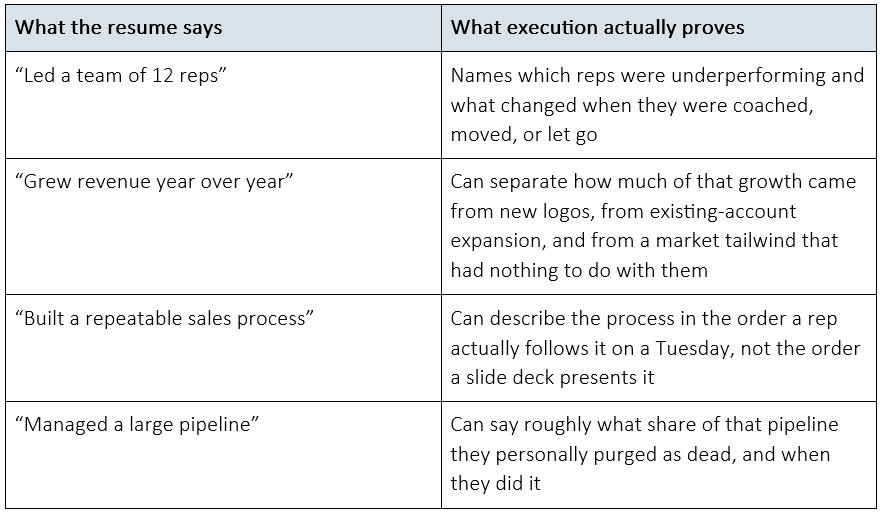
These four pairs work because each one forces a candidate to reconstruct the reasoning behind a result, instead of just reporting it. That's exactly the gap between a story and a proof. The offensive play most CEOs skip: ask a finalist to walk through a deal they lost last year, not one they won. Then listen for whether they diagnose it in process terms or blame terms. The second answer is the tell.
Three Checkpoints Before You Credit or Blame a New Sales Leader
Judging a new sales leader by the fiscal-year calendar, rather than by what the business needs at each point, is a mistake. It's how CEOs end up crediting a lucky quarter, or firing someone who was mid-fix. Three checkpoints work better than one annual review.
- 60 days: the forecast-category audit. The question isn't whether the number is right. It's whether deals are sorted honestly into commit, best case and pipeline, and whether that sorting holds up when a board member asks about a specific deal.
- 90 days: the pipeline-source audit. Where is new pipeline actually coming from, and has that mix changed from what the team was doing before the new leader arrived.
- 180 days: the close-rate-by-source read. Of the pipeline the new leader's process actually touched, what share closed, compared to the pipeline that was already in motion when they started.
These three checkpoints hold regardless of how the leader was hired, through a formal search or otherwise. What matters is the pipeline behavior, not who signed the offer letter. One cross-scope caution: a leader inheriting a team mid-reorganization needs the same three checkpoints, but on a longer clock. The pipeline-source signal takes longer to stabilize when the team itself is still changing shape.
The Three Numbers That Show a Sales Leadership Hire Is Working
Three numbers, tracked together rather than separately, show whether a sales leadership hire is producing a system change or just a temporary bounce. Watch forecast accuracy (committed versus closed), the share of rep time actually spent selling, and coaching cadence, because each one alone can mislead.
Forecast accuracy is the cleanest early signal, because it shows up before revenue does. Rep time on selling matters because it's the one lever a sales leader controls directly. Every hour a rep loses to admin work, approval chains, or CRM cleanup is an hour they aren't prospecting or closing. A leader who meaningfully cuts that drag is changing the machine, not just the message. Coaching cadence matters too, because of what it predicts downstream: a rep who gets real, regular coaching corrects course faster than one left to figure it out alone. A leader who builds a real coaching rhythm is investing in next year's number, not just this one.
The diagnostic logic is simple. If forecast accuracy improves but rep time on selling doesn't, the leader is managing the paperwork, not the people, and the gain usually stalls within a year. If time on selling improves but forecast accuracy doesn't, the leader is well liked but not rigorous. The miss tends to show up at the worst possible moment: quarter-end.
Track all three from day one, before the first quarter closes, not after a miss forces an explanation. That same discipline carries forward. When the review moves from a hiring conversation to an executive search, that tracking habit is the first thing worth bringing with you.
Check whether your new leader's forecast and close rate have moved together or apart since quarter one. Together is discipline. Apart is the tell, not the topline number, and it usually means win rate by source was never tracked. Not sure where to start? Ask what we'd check
Frequently Asked Questions About Evaluating a Sales Leadership Hire
What's a reasonable amount of time to evaluate a new sales leader?
Most CEOs want an answer by the end of quarter one, and that's too soon for anything except obvious red flags. The first two quarters are the honest window: the first shows whether the leader inherited a working system or a broken one, and the second shows what they actually did about it. Judging earlier usually rewards a leader for someone else's pipeline.
Is a fast first quarter a good sign when hiring a sales leader?
It can be, but only if you know what produced it. A fast first quarter built on deals that were already close to closing before the leader started says nothing about the leader. A fast first quarter built on a cleaned-up pipeline and a tighter forecast process says a great deal, and the two can look identical from the outside.
How many quarters should you give a struggling sales leader before making a change?
There's no fixed number, but the 60/90/180-day checkpoints above give you a better answer than a calendar date does. If the forecast-category audit and the pipeline-source audit both come back clean, but the close rate still hasn't moved by the 180-day mark, that's a process problem, not a patience problem. Waiting for a fourth quarter to “be sure” usually just delays a decision the data already made.
Who should own the forecast call, the new sales leader or the CEO?
The sales leader owns it operationally, but the CEO should sit in often enough in the first two quarters to hear how deals get categorized, not just what the total says. That's where forecast discipline is visible weeks before it shows up in the close rate.
What does a strong sales leadership candidate actually look like on paper?
Less impressive than the confident one, usually. A resume that names specific deals lost, and what changed afterward, tends to beat one that only lists deals won. That's because it shows the candidate has already done the diagnostic work this entire evaluation is built to test for.
What Actually Separates a Resume Match From a Revenue Match?
A sales leadership hire proves itself in the first two quarters' pipeline discipline, not the team's number. Full-quota attainment has fallen from 52 percent to 46 percent in a year. Average tenure in the seat has dropped from 26 months to 19. The CEOs who get this hire right check what produced the quarter, not just what it hit.
Answering that question before the offer goes out, rather than two quarters after it, is what a rigorous search is supposed to do. The evaluation above is yours to run either way. What we bring is a search built for scrutiny. If your next search needs that kind of rigor, let's talk.
References
- "The Average VP of Sales Tenure Has Shrunk. Here's Why." Gong. Published 2018-01-29 (last modified 2026-03-04). Verified live 2026-09-17.
- "The State of Revenue AI 2026." Gong Labs (analysis of 7.1 million sales opportunities across 3,600-plus companies and a survey of 3,000-plus revenue leaders). Published 2025-12-04. Verified live 2026-09-17.
