
The short answer: HR salary benchmarks in 2026 run higher than most open postings reflect. The median HR manager earns $149,280 a year. The median HR specialist earns $75,940. Private-industry management pay rose another 1.0 percent last quarter alone, per federal data. A range set at last year's numbers is already behind the market.
This guide is written for HR and People Ops leaders setting or defending a compensation range, not for candidates evaluating an offer.
In this guide:
- Why Is Your Posted HR Range Already Behind the Market?
- How Do You Rebuild an HR Salary Range From Current Data?
- What the Federal Numbers Actually Show, Role by Role
- If an HR Requisition Has Sat Open a Full Quarter, Re-Price It Before You Re-Post It
- The Three Numbers That Tell You Whether Your Range Is Working
- Frequently Asked Questions
- The Range You Post Is the Candidate You Get
- References
Private-industry management and professional pay rose 1.0 percent in the second quarter of 2026 alone, per the Bureau of Labor Statistics' Employment Cost Index. That is on top of whatever most HR budgets already priced in before the year began. The median HR manager now earns $149,280 a year. The median HR specialist earns $75,940, per the same agency's most recent wage survey. For an executive approving a requisition off last budget cycle's range, the posted number was already behind the day it went live.
This guide covers what moved in HR and People Ops pay this year. It shows where the widest gaps sit by role. It shows what a defensible range looks like before the next requisition goes out. Every figure below comes from published federal wage data.
Why Is Your Posted HR Range Already Behind the Market?
A posted HR range goes stale fast. Pay moves in the government's own wage data before anyone rewrites a job posting. Private-industry management and professional wages rose 1.0 percent last quarter alone. A range approved last budget cycle is already measuring last year's market, not this one.
Most HR ranges get set once, at budget time. Then they get treated as fact for a year. The Employment Cost Index does not work that way. It publishes quarterly. A 1.0 percent move in one quarter compounds against a range already built on a full year's lag.
The mismatch shows up first in the roles employers assume are already priced correctly: HR specialists, not directors. The federal median for an HR specialist is $75,940 a year. Many companies have not revisited that figure since before this year's cost-of-living conversations started. A specialist range set two review cycles ago is not slightly behind. It is behind by however many quarters of wage movement have happened since. None of them small.
Separately, SHRM-tracked compensation surveys put average 2026 salary increase budgets at 3.5 percent across functions, in line with 2025's actual increases. That is a company's own planned pay movement. It layers on top of the market movement the Employment Cost Index already shows. The two numbers answer different questions. A range review that checks only one of them is only half checked.
If your last HR posting still shows last budget cycle's number, it is behind. The current median runs $149,280 for a manager, $75,940 for a specialist. Off by a few thousand, a strong candidate is likely declining. Want a second read on it? Compare notes with us.
How Do You Rebuild an HR Salary Range From Current Data?
Rebuilding a defensible HR range starts from three things. First, the current federal median for the role. Second, the gap between that median and the average most tools default to. Third, the quarter's wage movement since the range was last set. Skip any one, and the range is still a guess wearing a number.
The Median and the Average Are Not the Same Number
The federal government publishes both a mean and a median wage for HR occupations, and they are not close. The mean annual wage for an HR manager is $164,230. The median is $149,280, a gap of roughly $15,000, or about 10 percent. For a specialist, the mean is $81,990 against a median of $75,940. Many compensation tools default to the averaged figure. A company that benchmarks off it is anchoring above what half the market for that role actually pays.
Recheck the Range Every Quarter, Not Every Budget Cycle
The Employment Cost Index publishes quarterly. A company that only revisits pay at budget time is working from old data by construction. That data can be nearly a year old by the time a new posting goes live.
Tying the recheck to the index's own publication schedule keeps a range current. It never turns compensation review into a full project every quarter.
What the Federal Numbers Actually Show, Role by Role
The rule is simple: benchmark against the median, not the average. Treat national data as the floor, not the finish line. Three federal medians anchor an HR and People Ops range for 2026. A manager: $149,280. A training and development manager: $133,000. A specialist: $75,940.
The table below is what a defensible 2026 HR and People Ops range should be checked against before it goes back into a posting.
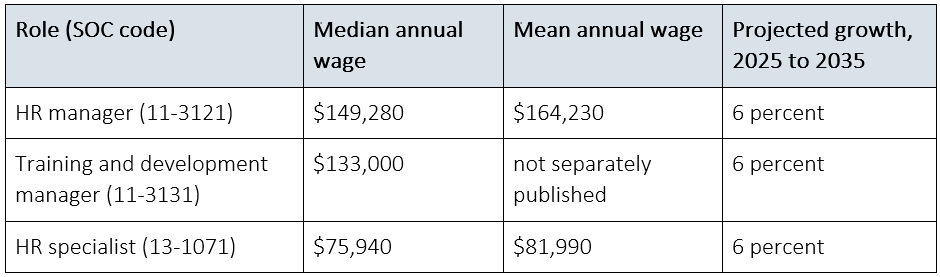
All three roles are projected to grow at the same 6 percent clip through 2035. So the gap between manager and specialist pay is not closing on its own. Specialist headcount also vastly outnumbers manager headcount nationally: 912,430 specialists against 220,660 managers, roughly four to one. Most of a company's HR pay decisions are specialist decisions, even when the negotiation everyone remembers is the director hire.
The offensive play most companies miss is the one buried in the first row of the table. Anchoring an HR manager range to the mean instead of the median overpays by roughly $15,000. That is against a candidate pool where half the market earns less than that. Moving the anchor to the median frees up that difference. It can move faster on the specialist reqs that make up most of a department's actual hiring volume. It does that without paying above the going rate for either role.
If an HR Requisition Has Sat Open a Full Quarter, Re-Price It Before You Re-Post It
A requisition that outlives one Employment Cost Index release runs on old pricing. It does not matter whether anyone updated the posting. Three triggers say it is time to re-price. A new wage release has published. Qualified candidates are declining once the range is disclosed. The role has sat open longer than a full budget quarter.
- A new Employment Cost Index release has published since the range was set.
- Qualified candidates are declining first-round interviews, or going quiet, once the range is disclosed.
- The requisition has been open longer than a full budget quarter.
Automate the calendar trigger, the reminder that a new release has landed, never the decision itself. A range adjustment is a human call, informed by data on a fixed clock. It should not happen only when a manager remembers to ask.
The Three Numbers That Tell You Whether Your Range Is Working
Three numbers say whether an HR range is working. The share of qualified applicants who decline after seeing the range. The number of qualified applicants per posting. Days to fill against the role's typical benchmark. Track a baseline on all three before the next range change, not after.
If decline-after-disclosure is high but applicant volume is normal, the range itself is the problem, and sourcing is not. If applicant volume is low but decline is normal, the posting is not reaching the right pool, and the range may already be fine. Read the two together, never one alone.
The government projects roughly 16,800 new and replacement HR manager openings a year nationally. It projects about 73,700 for specialists. Neither role is short on the turnover pressure that tests whatever range gets posted. A company that only checks its range when a search stalls is checking it too late. Both figures say the next stall is a matter of when, not if. For a broader look at what else should be in place before that next requisition goes out, see Journey's own hiring-practices guide. For how a direct-hire search actually finds the person once the range is right, see the firm's direct-hire explainer.
A hiring manager posts an HR generalist role at last year's number and gets three declines in a week. The market is not thin. The range is. Pull the current federal median before you re-post, not after the third decline. Not sure where to start? Talk it through.
Frequently Asked Questions
What is a compensation benchmark, and why does HR need one?
A compensation benchmark is a documented, dated wage figure from a named source. It checks whether an internal pay range still matches the outside market. HR needs one because an unchecked range quietly drifts out of date. It falls behind every time the market moves and the range does not.
How often should an HR salary range be reviewed?
Whoever owns the range should trigger the recheck, not wait for someone to notice it slipped. A range that misses even one Employment Cost Index cycle starts costing declines and slow fills. Waiting for the next budget conversation to catch that is the expensive version of the fix.
Does national wage data apply the same way in every region?
Not exactly. A national median is a floor and a reference point, not a finished regional number. A Twin Cities range should be checked against state-level wage data where it exists. Adjust from the national figure; do not replace it outright.
Who should own salary benchmarking inside a growing company?
Ownership works best with one named person, usually in HR or finance. That person checks the range against a dated source on a fixed schedule. The task should not default to whoever built the original range and then never revisit it.
What does it actually cost a company when an HR requisition sits open too long?
The direct cost is the work nobody is doing while the seat stays empty. The compounding cost is that the reopened search often gets no better a range than the one that failed the first time. Nothing about the underlying data was rechecked in between.
The Range You Post Is the Candidate You Get
If your last HR posting used a range nobody rechecked, the pattern is familiar. Qualified people go quiet after seeing the number. Others negotiate hard once an offer arrives. The median HR manager earns $149,280 this year, and the median specialist earns $75,940, both moving every quarter. A range that was right in January is not automatically right now.
Setting the range is a compensation decision only the hiring company can make, and Journey Search Partners does not set it for the client. What the firm does is find the right hire once that range is set. It runs a direct-hire search built around the actual requirement, not a resume count. That includes executive and leadership roles, where the cost of a stale range is highest. If your last HR posting needs a second look before it goes back out, get in touch.
References
- "Employment Cost Index Summary, Table 9." U.S. Bureau of Labor Statistics. Published August 3, 2026. Verified live September 16, 2026.
- "Human Resources Managers." Occupational Outlook Handbook, U.S. Bureau of Labor Statistics (compiling May 2025 Occupational Employment and Wage Statistics data). Published undated. Verified live September 16, 2026.
- "Human Resources Specialists." Occupational Outlook Handbook, U.S. Bureau of Labor Statistics (compiling May 2025 Occupational Employment and Wage Statistics data). Published undated. Verified live September 16, 2026.
- "Table 1. National Employment and Wage Data From the Occupational Employment and Wage Statistics Survey by Occupation, May 2025." U.S. Bureau of Labor Statistics. Published 2026. Verified live September 16, 2026.
- "Training and Development Managers." Occupational Outlook Handbook, U.S. Bureau of Labor Statistics (compiling May 2025 data). Published undated. Verified live September 16, 2026.
- "Employers Eyeing Flat Salary Increases in 2026." SHRM (compiling a Willis Towers Watson survey). Published July 21, 2025. Verified live September 16, 2026.
