
The short answer: In our working test, a company needs a COO when two of the seven reasons companies create the role are true this year. Harvard Business Review documents them, from a strategy the CEO can't run alone to a successor to test. Feeling stretched isn't one. Only 40 percent of leading companies had a COO in 2022, per McKinsey.
Written for founders, CEOs and owners deciding whether to add a chief operating officer, on the employer side of the hire; how a COO candidate should weigh an offer is a separate subject.
In this guide:
- Why isn't feeling stretched a reason to hire a COO?
- How do you know if your company needs a COO?
- The Seven Reasons Companies Create the Role, and What Each Demands
- Three Moments That Decide Whether the Hire Works
- Three Numbers That Show the COO Is Working
- Frequently Asked Questions
- A COO Answers a Specific Question, Not a Feeling
- References
Large companies have gone back and forth on the seat. In 2000, 48 percent of Fortune 500 and S&P 500 companies had a COO, according to McKinsey's summary of the data. By 2018 the share had fallen to 32 percent. McKinsey also cites 40 percent of leading companies for 2022, a group it does not define. If the biggest companies keep adding and removing the seat, it is not a milestone every growing company reaches. It is a choice, with a reason or without one.
Our own searches start from the same idea. Timing, the third letter of our PATH search process, reads: "We work with urgency to find you the right talent exactly when you need it. Our searches move quickly because we know the right person at the wrong time is the wrong hire." For a COO, that sentence cuts both ways. Hire before a real reason exists and the role has no job. Wait past two reasons and the CEO keeps running operations alone.
This guide covers why being busy is not the signal, how to test for the real one, and the seven reasons the role exists. It ends with the moments that decide the hire and the numbers that show it worked, built on the PATH process we run on every search.
Why isn't feeling stretched a reason to hire a COO?
Feeling stretched is the normal state of the job, not a trigger. In Harvard Business School research reported in 2018, large-company CEOs worked an average of 62.5 hours a week and spent 72 percent of their work time in meetings, per CNBC's report on the study. A COO doesn't change that. A reason does.
The study, which drew on 60,000 hours of data on 27 executives, found CEOs giving 25 percent of their work time to functional and business unit reviews and 21 percent to strategy. They also worked 79 percent of weekend days. Those numbers describe the job at its most demanding. They don't describe a gap that a second executive closes.
That is the misconception worth naming. A CEO who hires a COO to feel less busy risks ending up with a capable executive and no defined job for them. The CEO keeps taking the operational calls, because nobody decided which ones moved. The new hire drifts toward whatever is loudest, and both of them start asking what the role is for.
Busy is a symptom. A COO is an answer to a specific question, and the question comes first.
How do you know if your company needs a COO?
You know when you can name the reason, the job and the trade. Harvard Business Review's 2006 study of the role found seven distinct reasons companies create it. Count how many are true this year, write the job before the title, and decide what the CEO gives up. Two true reasons is our working test.
Three foundations make that test hold up.
1. Count the reasons that are true this year
In our judgment, one reason is rarely enough. A single trigger, such as a big initiative, can often be handled by a strong VP of operations or a project lead. When two reasons stack, say a strategy you can't also run plus a successor you want to test, the work crosses functions and needs an executive with the authority to match. Count the reasons, not the hours.
2. Write the job before the title
A COO search goes wrong when the title is defined and the job isn't. Our intake call starts here. As our intake process describes it, the team "will ask questions about things like your criteria, timeline, and both technical and personal requirements for the role(s) you need to fill." For a COO, write down the three decisions you will stop making the day they start. If you can't name three, the job isn't ready yet.
3. Decide what the CEO gives up
A COO only works if the CEO stops doing something. Name the meetings you will leave, the direct reports who will move and the decisions you will no longer review. Our guide to roles companies forget shows how work lands on whoever is nearest when nobody assigns it. Then tell the leadership team before the search opens, not after the offer. Honesty, the fourth letter of PATH, reads: "The greatest, most enduring successes are built on honest work." That includes being honest with yourself about what you will let go of.
How many of last month's meetings would a COO have run instead of you? Mark them. If you can't name any, the role has no job yet. Not sure which meetings belong to which role? Ask what we'd check →
The Seven Reasons Companies Create the Role, and What Each Demands
Each of the seven reasons calls for a different COO. Bennett and Miles's 2006 Harvard Business Review research lists them: implement strategy, lead an initiative, mentor a CEO, complement a CEO, partner with one, test a successor or keep a valued executive. The reason sets the profile you search for.
The table below matches each reason to what it looks like this year and what the hire must bring.
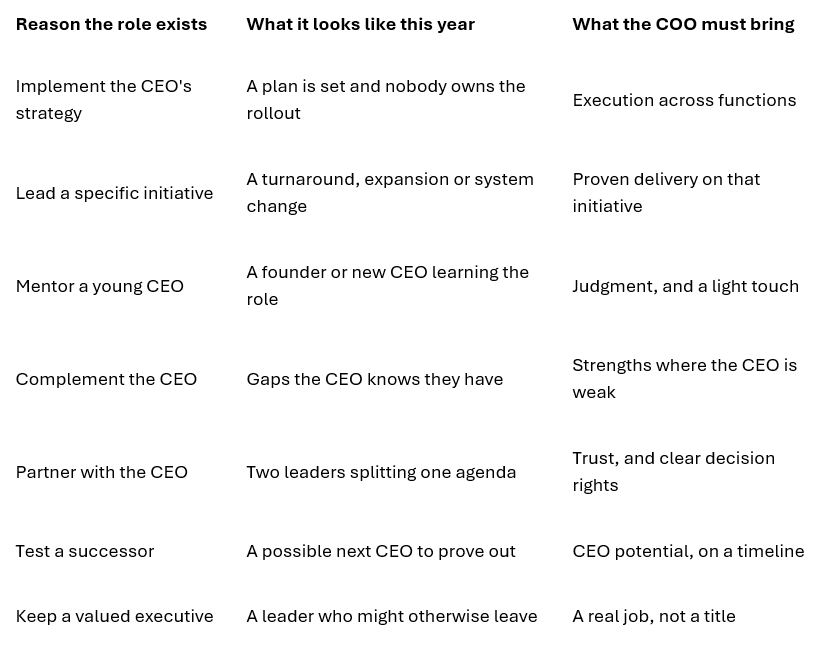
Two field notes explain why the match matters. First, the last reason is the riskiest. HBR names it as staving off "the defection of a highly valuable executive, particularly to a rival," and in our view a title created only to keep someone rarely comes with work attached. Second, the successor reason changes the search itself. McKinsey reports that nearly 27 percent of Fortune 500 and S&P 500 CEOs in 2021 were promoted from the COO role, more than from any other internal post. If succession is one of your reasons, you are hiring a possible CEO. Search for one.
Look for the reason, not the résumé line. A candidate who ran operations for a CEO with the same gap you have is worth more than one with a bigger title. That is Precision, the first letter of PATH: "Our searches are highly intentional. We don't cast wide nets, we target with surgical precision, aligning technical skills, leadership style, and cultural fit." Match the person to the reason.
Three Moments That Decide Whether the Hire Works
A COO hire succeeds or fails at three moments: the decision, the search and the handoff. Each needs a date before the search opens. Setting the dates first forces the owners or board to agree on why the role exists. Without that agreement, every interview tests a different job.
- Decide the reason in writing. Before any outreach, write which two or more of the seven reasons are true and get the board or owners to agree. In our experience, a COO candidate asks why the role exists on the first call. A vague answer ends the conversation.
- Set the search calendar before the first interview. Agree the interview panel, debrief dates and decision date in advance. Speed comes from never waiting on a calendar, not from rushing the evaluation.
- Plan the handoff before the offer. List the direct reports, meetings and decisions moving to the COO, with a date for each. In our experience, a handoff with no dates rarely finishes.
The rule behind all three is to automate the timing, never the human moment. Reminders and calendar holds can run on their own. The conversation that tells your leadership team their reporting line is changing should come from you, in person. The broader operations bench matters too: BLS counts about 3,599,000 general and operations manager jobs in 2025, projected to grow 5 percent. A good COO leads that bench, not another layer above it.
Three Numbers That Show the COO Is Working
Three numbers show whether the COO hire worked. Track the CEO's hours in operational reviews, the decisions that still escalate and the CEO's time on strategy. The 2018 study's 25 percent on reviews and 21 percent on strategy are a reference point.
Pull your own baseline before the COO starts, from last quarter's calendar. Then track the three as a set at 90 days and again at 12 months:
- CEO hours in operational reviews. Count the hours a month you spend in functional and business unit reviews. This number should fall as the COO takes them over.
- Decisions that still escalate. Count the operational decisions that reach you each week. If the number doesn't drop, the COO has the title but not the authority.
- CEO time on strategy. Count the hours on strategy, customers and the board. This is where your freed time should go.
Read the combinations, because each points to a different fix. If review hours fall but escalations don't, the COO is attending meetings without owning decisions: revisit decision rights. If escalations fall but strategy time doesn't grow, the CEO has filled the space with new operational work. If neither moves, go back to the reason the role was created. Our guides on hiring a CEO and building a leadership bench cover the seats around it.
Picture the COO's first Monday: three direct reports move to them, two standing meetings leave your calendar and one decision stops reaching you. If you can't name those, the search would fill a title, not a job. Want a second read before it opens? Talk it through →
Frequently Asked Questions
What does a chief operating officer do?
A COO runs the company's day-to-day operations and carries out the strategy the CEO and board set. The scope varies by company and often covers several functions at once. BLS describes the COO as a type of chief executive.
Is a COO the same as a president?
Not always. Some companies give one person both titles, while others split them, with the president facing outward and the COO running operations. What matters is the written list of decisions each person owns.
Should a small business hire a COO?
Only when a specific reason exists, such as a founder who needs an operating partner to scale. Many smaller companies are better served by a strong general manager or operations director first.
Is a COO different from a general manager?
Yes. A general manager usually runs one business, site or unit, while a COO works across the whole company beside the CEO. BLS counts general and operations managers, about 3.6 million jobs in 2025, separately from chief executives.
Should you promote a COO from inside or hire from outside?
Promote from inside when someone already does much of the job and the team accepts them. Look outside when the reason calls for experience nobody on your team has, such as a turnaround.
A COO Answers a Specific Question, Not a Feeling
A COO is not a reward for growth or relief for a busy CEO. With CEOs averaging 62.5 hours a week and only 40 percent of leading companies keeping the seat, the companies that hire well do three things. They name the reasons that are true, write the job before the title and plan what the CEO gives up.
The decision about whether your company needs one is yours, and it should be. BLS projects about 304,100 openings a year for top executives through 2035; few of them will fit your reason, and finding the one that does is the work. Finding the operating executive who fits that reason, and testing them against it before they reach you, is what we do through executive search and operations recruiting at Journey Search Partners. If you have counted two reasons and want to talk them through, connect with our recruiters.
References
- "Why do organizations have COOs?" McKinsey and Company. Published 2023-12-06. Verified live 2026-10-13.
- "Second in Command: The Misunderstood Role of the Chief Operating Officer." Nate Bennett and Stephen A. Miles, Harvard Business Review. Published 2006-05-01. Verified live 2026-10-13.
- "How CEOs Manage Time." Michael E. Porter and Nitin Nohria, Harvard Business Review. Published 2018-07-01. Verified live 2026-10-13.
- "Harvard study: what CEOs do all day." CNBC (reporting Porter and Nohria's Harvard Business School research). Published 2018-06-20. Verified live 2026-10-13.
- "Top Executives: Occupational Outlook Handbook." U.S. Bureau of Labor Statistics. Published 2026-08-27. Verified live 2026-10-13.
